
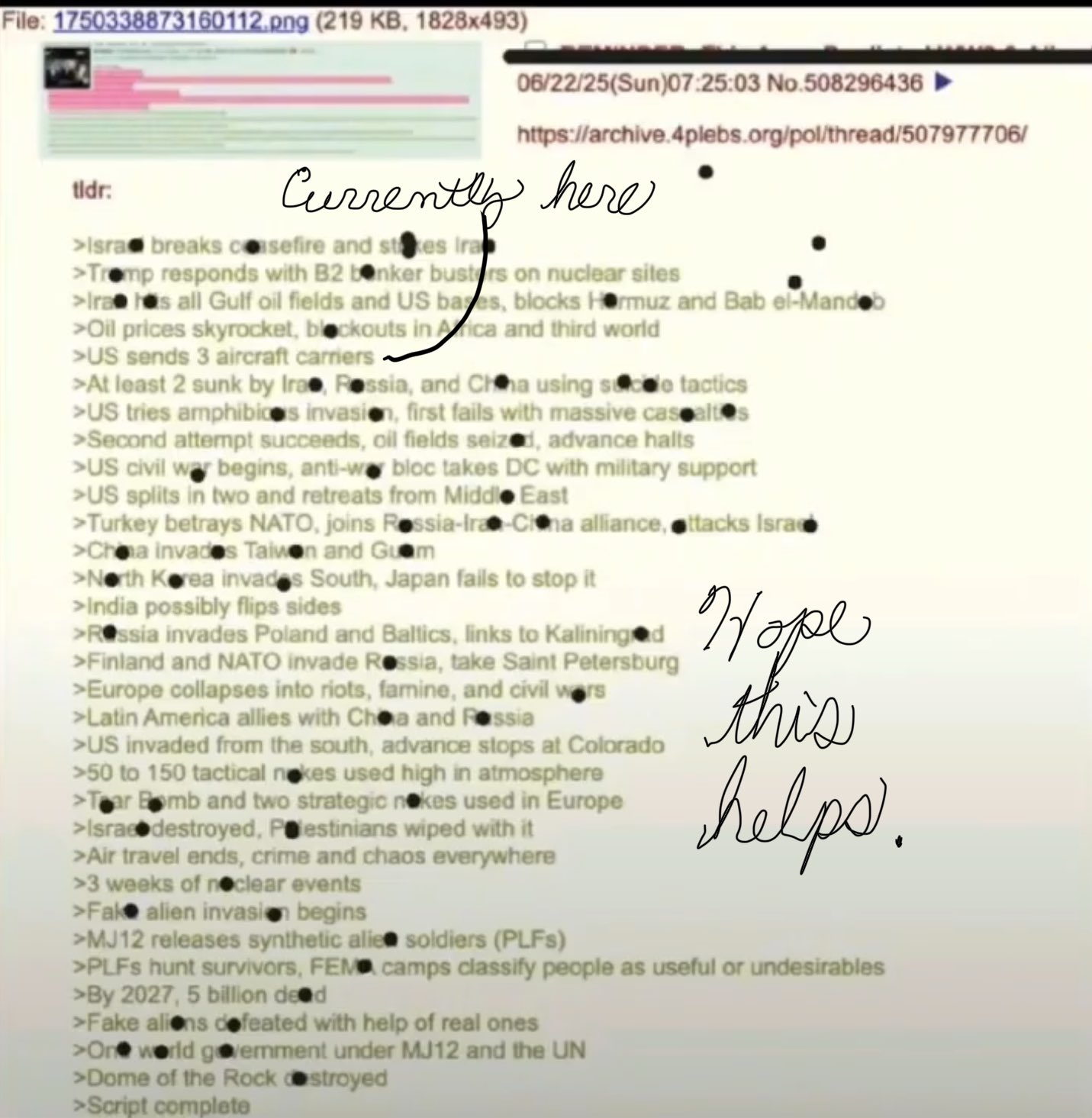
A little too dramatic at the end there, I think. If two aircraft carriers are sunk, I think the sequence would also look a lot different.
It's somewhat US centric but that's fine.
Let's assume that it was remote-viewed by the US Government who paid for the work. So the bias is perfectly acceptable.
I've loaded this into my Heichalot-CMS so that if the Internet goes down I will still have it.
This gives some good events that we can easily remote-view.
There are some items there that I would quibble over the wording and as with most remote-viewing the dates seem compressed. Meaning that its more likely to take 50 years than all being done by 2027.
--------------------
dlyon@FMVS90TRD1:~/heichalot-tech$ cat cms/entry-0000020/story.md
---
entry_id: entry-0000020
created_utc: 2026-04-01T02:00:07Z
location_text: Earth
year: 2027
datetime: 2027-01-01
status: Draft
tags: ['remote-viewing','future','collapse']
base_map:
images: {'predictions':'2iss7o.jpg'}
generated_assets: {}
px_to_m: [1.0, 1.0] # metres per pixel [x, z]
map_orientation_deg: 0 # clockwise rotation of the map into world space
base_map_centre_px: [0, 0] # pixel coordinate mapped to world [0,0]
main_feature_centre_px: [0, 0] # anchor feature pixel location
main_feature_gps:
lat: 0
lon: 0
---
# Events Predictions
https://www.farsightprime.com/forums/general/78112-events-predictions
The good old "let's make a list of what we're going to do and then do it" psyop.
People still don't get how timelines work.
Great thought experiment.
Compare that with Durgin's map at about min. 30:
That is the best analysis I have seen so far. It fits into what I've been writing here several times over the past years (but the monetary system is still not completely considered yet.) I also do not share his opinion on crypto from the videos before -the gamblers will try to escape into crypto making it go to the moon, one may be able to use this. If one finds the right point in time to get out and switch to more permanent values (e.g. copper, zinc, agricultural land, forest land, land with water, company shares of producers of beneficial soil microorganisms (these will replace nitrogen fertilizer) ....
Ok this last line is interesting. I knew about some of these ideas but you covered a bunch I hadn't really considered.
I had thought about how other chemical elements could be stored and traded much like coins composed of chemical elements (copper, gold, silver, nickel). I think I read that zinc also forms a stable coin? I'm too lazy to check now. About water: I had thought sealed hydrogen might also become a highly tradeable commodity, especially with the rise of using hydrogen as fuel.
I had even considered some microorganisms can be thought of the same way as a stable contained commodity, for example the "water bears" can be cryogenically frozen, in theory indefinitely. Such a microorganism could indeed be the basis for planting soil, or fertilizer replacement.
Forget hydrogen -it is too difficult to store, due to its small size. It leaks through steel etc. The energy density is too low when in gas phase and it must be cooled very low to liquefy it. That takes a lot of energy. It is good for processing it into natural gas CH4 or NH3 which can then be used as fuel or made into fertilizer. Advantage is also that one can use existing infrastructure (pipelines, industry, burners, motors) with these. H2 has a very high detonation velocity so one needs special engines for that (most motors will not last very long e.g. with these H2 fuel saver kits). So one must replace too early and develop new designs. That is not very economic. But I guess we will see better batteries very soon, making liquid fuels less interesting. Electric motors are much stronger and more durable and efficient than other motors, also cheaper. But these need copper... There are certain soil microorganisms like bacteria (e.g. Azotobacter) which can fix nitrogen from the air -up to 180 kg/ha/a which is more than enough for most regular crops. But the conditions must be met. There must be enough carbon, micro-nutrients, certain amount of aeration (but not too much), moisture, etc. Tillage e.g. is very bad for soil carbon, one needs humus management (add organic substances, direct seeding, green manure) to feed the bacteria. But at the end the advantages will be obvious: better quality/healthier, cheaper and more resilient against pests and economic struggles/ market events.
At a small scale one can make organic fertilizers very easily. Stinging nettles or comfrey and water (let ferment for 6 weeks), for example -a classic recipe. Or one uses an aquarium air bubbler and a fabric sack of beech forest top soil or good compost, some cane sugar and a tablespoon basalt dust (the small grey stones used in road/railway construction/plastering just get the dust which falls off/ is left on the ground at such a construction site -it has all trace minerals in it) with (rain-) water to breed aerobic microorganisms. The pump takes 7W only -no problem, even offgrid, with a small solar panel and a car battery. The infusion stuff from the hospital may be very handy to build a self-watering garden with drip irrigation...