I think it's important to understand how valid targets can be created, even if you just want to be a viewer. In my opinion, understanding how targets work will make you a better viewer, just like understanding how cars work will make you a better driver. So, here we go...
Everything starts with a question, right? For example: What created the ISBE?
Step 1 – Understanding the Question
As a tasker, you have to understand the implications of the question. Think about it like this: You want to draw a map, and you want the viewer to spot the exact location on that map. Understanding the implications means that you know that the map will include secondary targets.
You can influence the viewer where to look on the map to a certain degree, but you also don't want to take away the viewer's freedom by limiting the map to what you think how it should look like. Let's look at the example question: What created the ISBE? Asking for the implications means to dismantle the question, analyze its parts, and map the possibilities:
Starting the question with "What" means that you're asking for a cause, and you don't limit the cause to a person or being. What could mean anything. So you already know: The viewer could come up with anything. At this point it's important to be aware that you, as the tasker, already have an opinion. This will be important in step 2, but let's first complete step 1.
The second word of the question is "created". This word tells you that you already have made a choice. You presume that ISBEs are created. At this point it's important to be aware that the question doesn't ask for different possibilities. What if ISBEs aren't created? How could the viewer see this possibility if you, as the tasker, don't ask for it?
The third part of the question is "the ISBE". You as the tasker need to be aware that this term is a concept that is composed of many ideas. You need to ask: What is an ISBE to begin with? And: Does the viewer even have to know what an ISBE is?
Step 2 – Drawing the Map
When I create a target, I draw this map in my mind. If you don't understand why this map is important, I suggest you start drawing it on paper or on the computer, so you can see it in front of you. Here's how I draw the map regarding the example:
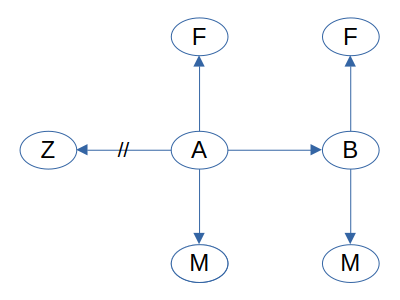
I start by putting an A in the center. The A represents the starting point of the target. It's important to be aware that you, as the tasker, don't know the exact reality of the target. You have an opinion, but you don't want the viewer to be limited to your opinion. You want the viewer to reach the reality of the target, even if your opinion of the target is wrong.
Next, I take the parts I identified in step 1 and add them to the map. What asks for a cause. This is the A that's already on the map. Because it's a cause, I also add the effect. I put a B on the right side of the map. The B stands for the creation aspect that's part of the question. A and B are connected by a causal relationship, so I connect them with an arrow.
As you can see, we are drawing a graph, which tells us that the target has multiple dimensions. This means that the viewer already has two focuses to look at: the creator and the process of creation.
Now a very important step: I add a Z on the left side of the map. The Z reflects the possibility that the question asks for the wrong thing, meaning the possibility that ISBEs aren't created by a creator. The Z is not connected to the A in the center, because if that possibility is true, there is no causal relationship. Being aware of this enables the viewer to look for either A or Z, independent of what you as the tasker believe the viewer should look at. I draw an arrow with // in the center indicating that it's not a causal relationship.
Programmers should have noticed by now that we are drawing a simple flow chart.
Now back to the B on the right side. B is the part where the viewer will focus on the ISBE that is being created. Because the ISBE is an idea that's based on multiple assumptions, we have to put at least two more letters on the map: One for the opinion of the tasker, and at least one for other possibilities. Doing this has only one purpose: We don't want to limit the viewer to one route. The tasker could be wrong about the target, so we have to map alternative routes.
I personally put an M for my opinion (M stands for the german word "Meinung", which means opinion), and an F that stands for Freiheit (freedom). If the viewer reaches the M, it means that my opinion matches the target. If the viewer reaches the F instead, it's because my opinion is wrong. The F then enables the viewer to go where he or she wants to go, leading to unexpected results.
The same is true for the A in the center, which is the cause. I draw an M for my opinion about what the cause is, and an F for every other possibility that's not my opinion. The map now looks like this:
Step 3 – How to Formulate the Target
The map is a simplified depiction of the routes the viewer can take. As you can see, it's also a matrix. The number of columns tells you how many focuses there are. In this example, there are two focuses: the cause and the effect.
The Z is not a focus, but you have to consider it as an alternative route when formulating the target. It should work like a fallback for the given focuses, so you have to formulate 4 focuses instead of 2, but with only 2 focuses visible to the viewer.
Example:
(A) The viewer will perceive and describe the reality of the process that creates a new ISBE, as defined by Focus 1 and 2.
(Z) If the process that creates a new ISBE is not real, the viewer will perceive and describe Focus 3 and 4 instead.
Focus 1: The cause that starts the process of ISBE creation.
Focus 2: The ISBE that is being created.
Focus 3: A tree with green leaves.
Focus 4: A red car.
We tell the viewer that there are only 2 focuses. If the viewer describes a tree when looking at Focus 1 and a red car when looking at Focus 2, we know that the process of creating a new ISBE is not real.
Step 4 – The Limits of Perception
We should also be aware that, in this example, we are asking the viewer to perceive something that could be outside the viewer's scope of perception or ability to describe it correctly. Because of this, we should add a restriction:
(R) If necessary, the viewer will perceive the reality of the target in a way that can be described in metaphoric language. The viewer shall use metaphors that describe the underlying principles in the best way possible.
This restriction is only required if the target could be a non-physical reality. Be aware that viewers will come up with metaphors even if we don't add this restriction, because they always expect to see something. But adding the restriction tells the viewer that the metaphors are not AOLs.
Conclusion:
Creating a target is not as simple as most people think. While you can simply ask any question, most people ignore that questions are already built on assumptions. Especially the possibility of asking the wrong question must be taken care of when formulating the target, otherwise the viewer will be limited to the tasker's beliefs. We want to enable the viewer to distinguish between thoughts and physical reality, so the target wording has to reflect this ability.
As far as I'm concerned, most taskers, including Courtney, ignore the possibility of asking the wrong question. It's possible that the ETs who Farsight uses as a proxy compensate for this deficiency when the viewer connects to the target. But it's also possible that the viewers just remote view Courtney's thoughts and opinions.
It's important to be aware that if the tasker's opinion about a target is true, and the target is verifiable, the viewer will see what is true. But if the opinion of the tasker doesn't match reality, and the tasker doesn't specifically ask for reality in spite of his own opinions, the viewer can still see what the tasker thinks to be true. This will only be recognized if the target is verifiable and the collected data doesn't match physical reality.